Product tour
The actual app, filled with sample data
These are screenshots of the running product, not mockups. The catalog, the competing sellers and the numbers are invented for the tour; the screens, the wording and the behaviour are exactly what you get.
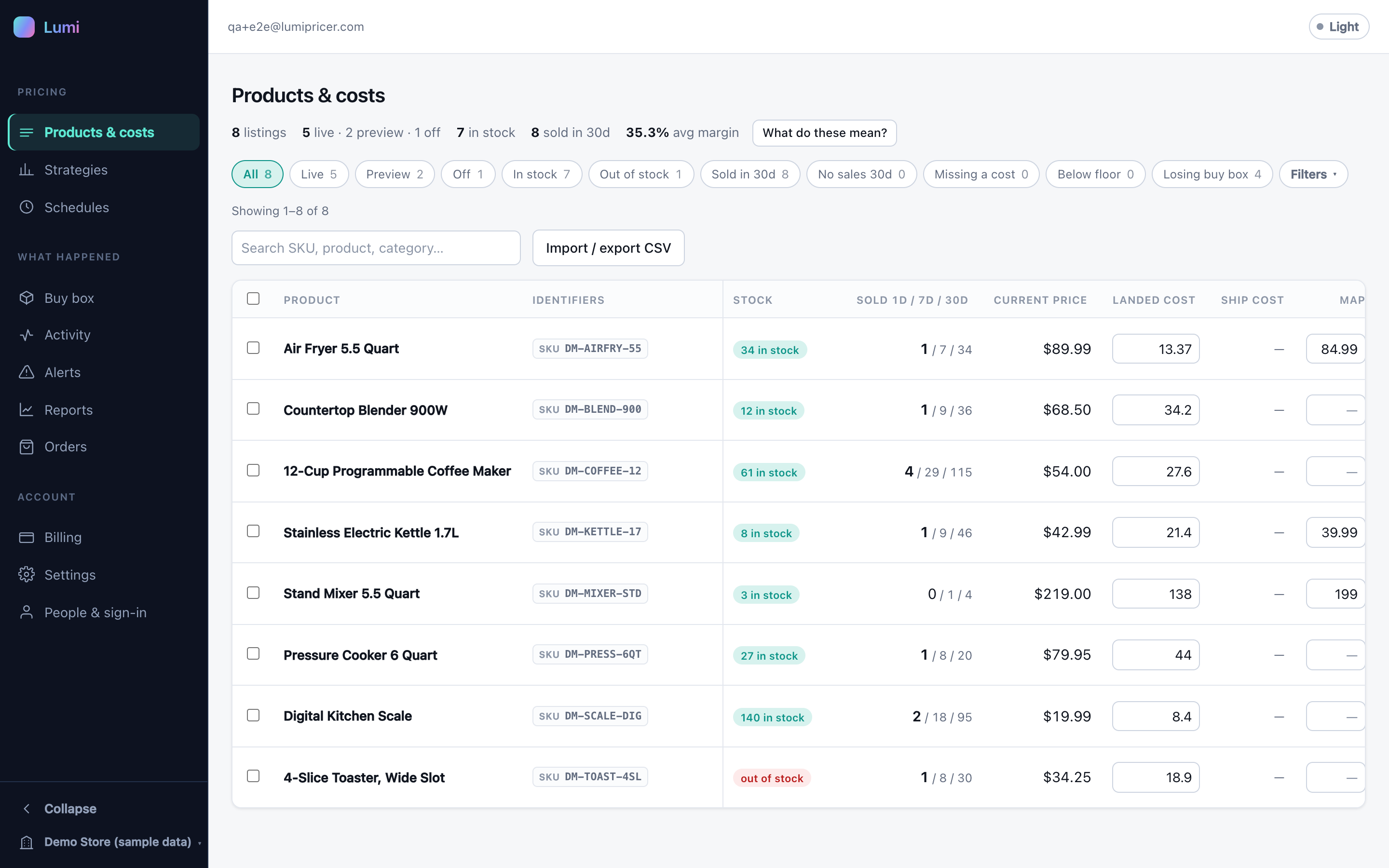
Costs, the floor they create, and Off / Preview / Live
Enter what an item costs you landed. Lumipricer turns that into a margin floor — your cost plus fixed costs, grossed up for the referral fee — and no strategy may price below it. Import a spreadsheet when you have thousands.
Each listing is Off, in Preview, or Live. Preview makes the real decision against the live market and sends nothing, so you can watch it work on your own catalog first. Neither can be switched on without a cost: with no floor there is nothing to protect, and simulating against a guess would only show you prices the engine would refuse to send.
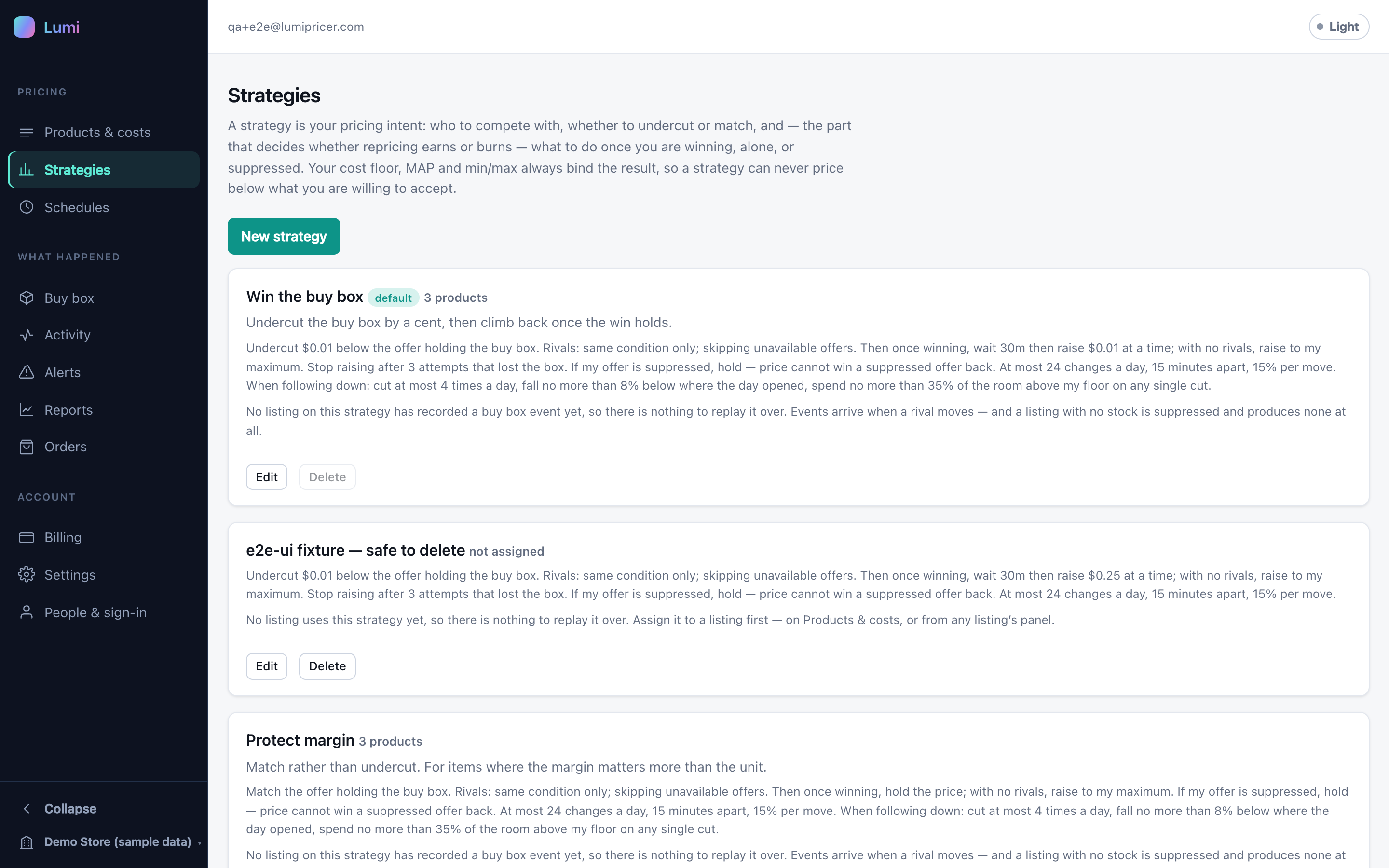
Strategies you can read back as a sentence
Choose who to price against, whether to undercut, match or sit above, which rivals even count, and what happens once you are winning, alone, or suppressed. Each strategy shows a plain summary of what it will actually do, so you recognise it before you save.
The last line of each summary is the descent budget: how often this strategy may follow a rival down, how far it may fall from where the day opened, and how much of the room above your floor one cut may spend. Clearing your floor is not the same as being worth it — $20 to $15.99 against a $15 floor is legal and spends 80% of what you had to compete with.
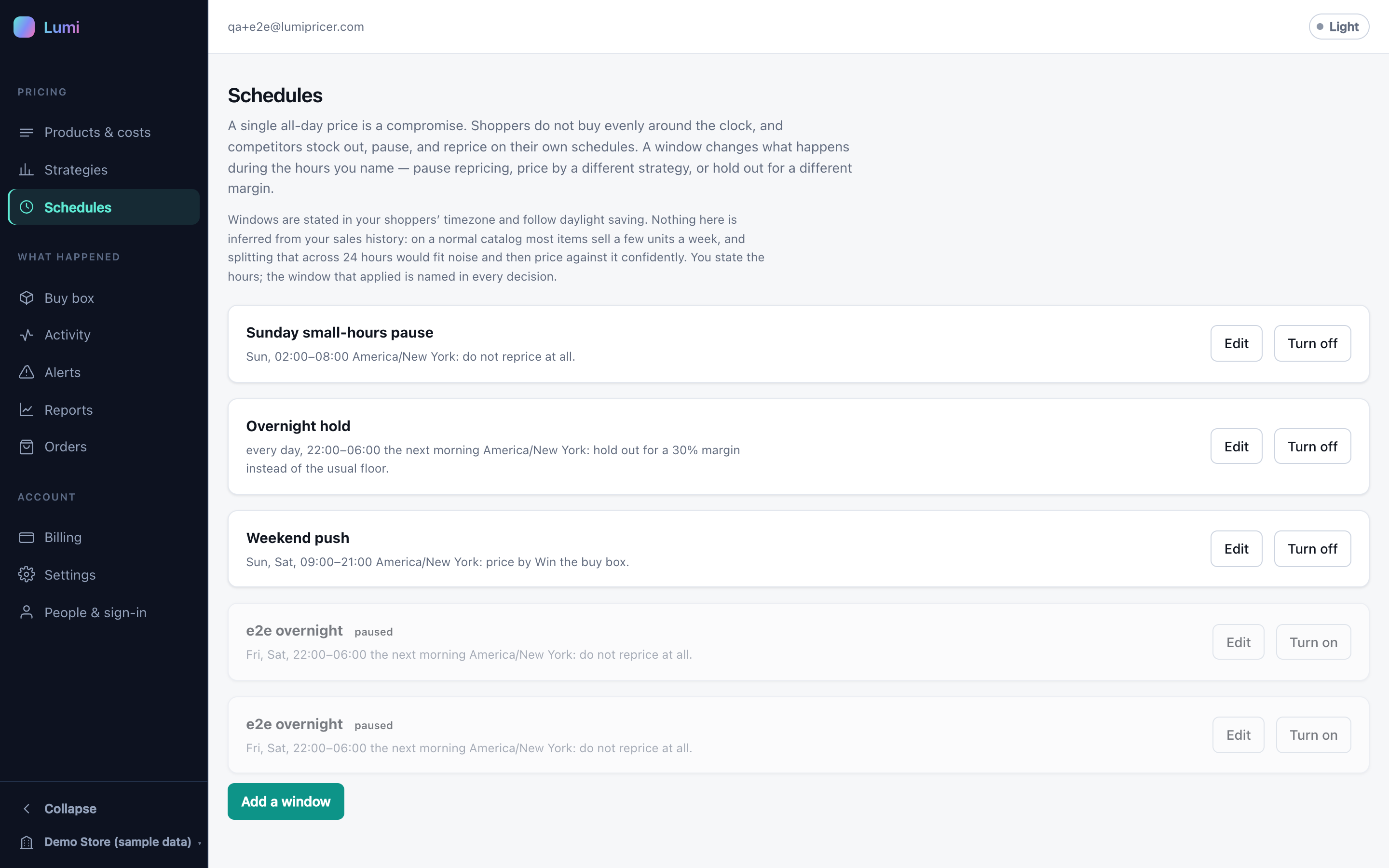
Hours that behave differently
Competitors stock out overnight, pause at weekends, and reprice on their own schedules. Name the hours and a window will pause repricing, switch strategy, or hold out for a fatter margin. Times are your shoppers’ local ones, daylight saving included, and a window may run past midnight — overnight is usually the reason you want one.
Nothing is inferred from your sales history. Doing that honestly needs per-hour conversion data on each listing, and on a normal catalog most items sell a handful of units a week — split across 24 hours that is noise, priced against with confidence. You state the hours, and the window that applied is named in the decision.
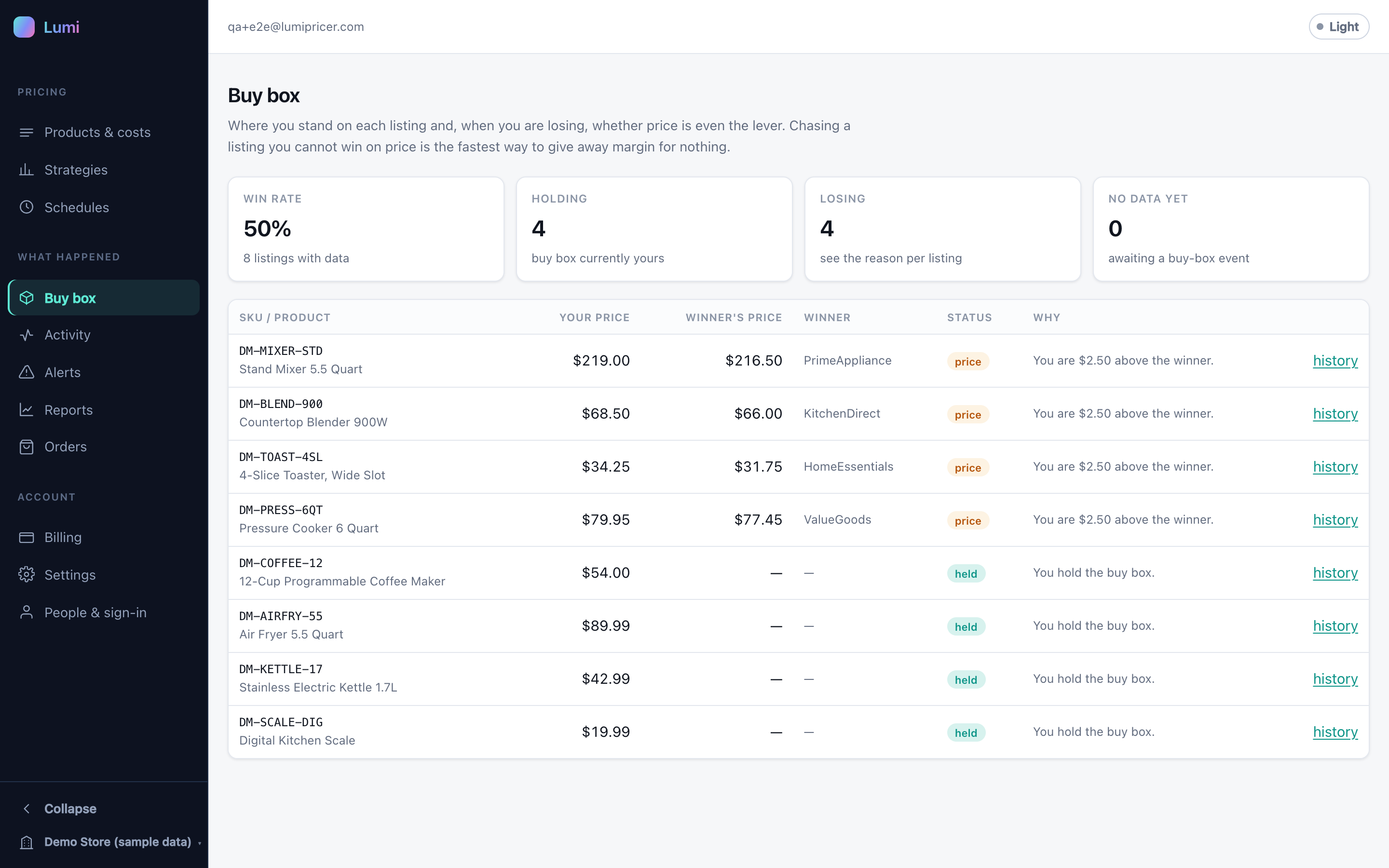
Not just that you lost — whether price is the lever
A suppressed offer or a fulfillment disadvantage cannot be fixed by undercutting, and chasing those listings gives margin away for nothing. Each row says which case it is, instead of showing a gap and leaving you to guess.
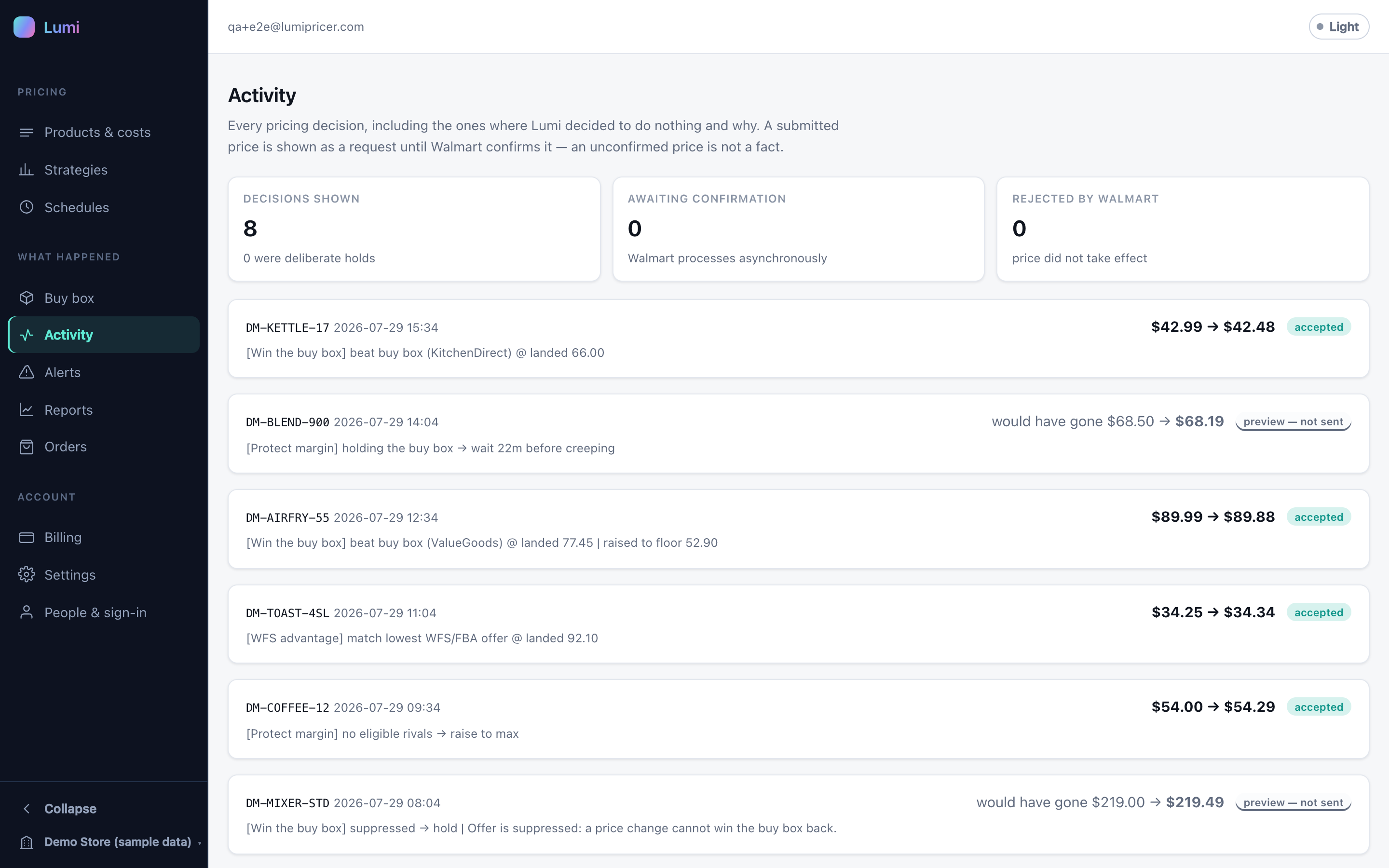
Every decision, including the ones to do nothing
Each entry carries the rule that fired, the competing offers at that moment, and the guardrail that bounded it. A submitted price stays marked as a request until the marketplace confirms it — an unconfirmed price is not a fact, and Lumipricer will not build the next decision on one.
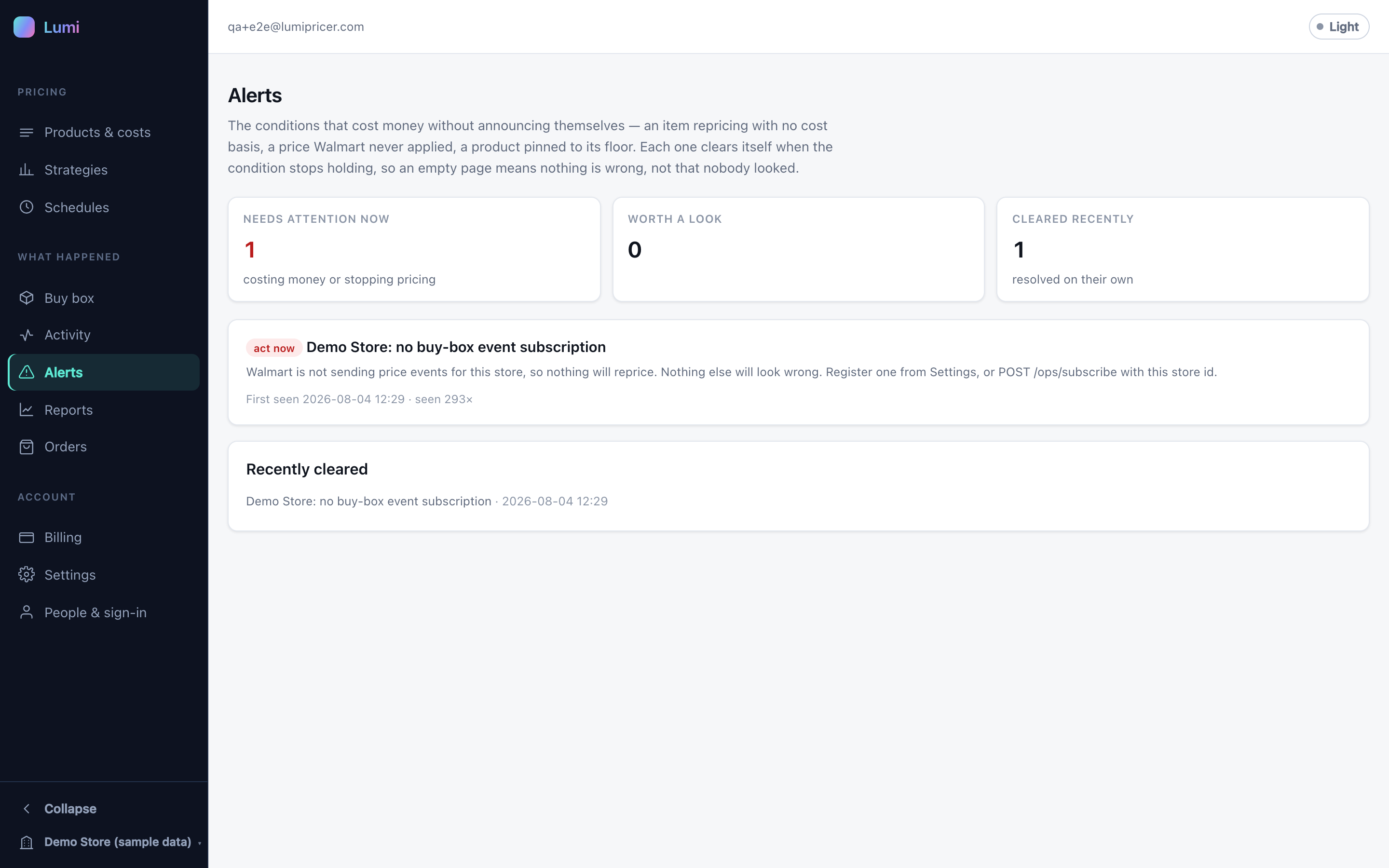
The problems that never announce themselves
An item pinned to its floor looks like it is being repriced. A rejected price looks like a change. Repricing enabled with no cost looks like it is working. Lumipricer goes looking for these, pairs each with what to do, and clears them once the condition stops holding — so an empty page means nothing is wrong, not that nobody looked.
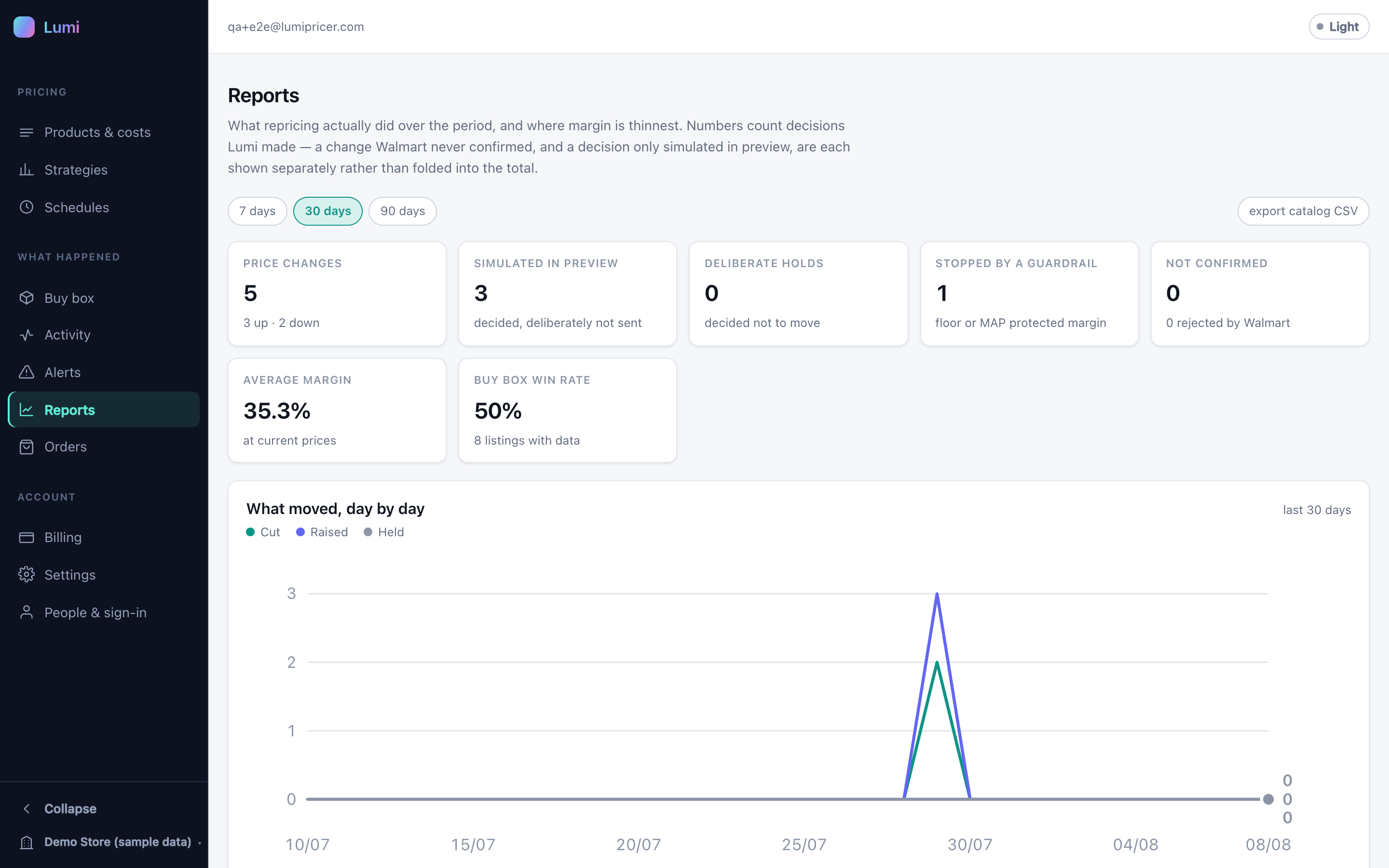
What repricing actually did — and what it only rehearsed
Changes up and down, decisions to hold, how often a guardrail stopped a cut, how many changes the marketplace never confirmed, and how many were simulated in Preview — each kept separate rather than folded into the total, because counting a change nobody confirmed, or one that was never sent, overstates the work done.
Built for Walmart Marketplace first. Amazon support is in progress.